 Runclubs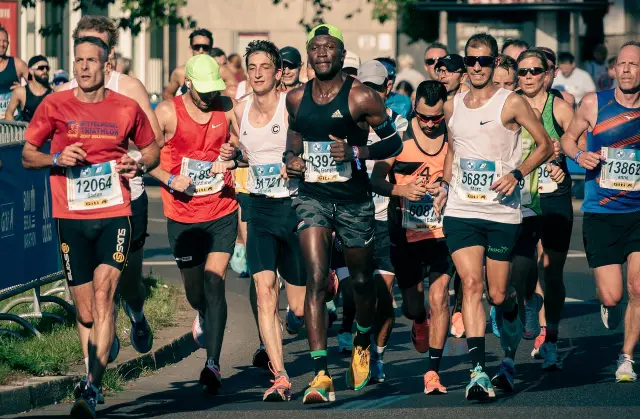
The benefits of group running
Updated July 22, 2026 · 6 min read
Every runner who joins a club says a version of the same sentence within a month: "I should have done this years ago." Not because solo running is bad — it isn't, and most club runners still do plenty of it — but because a handful of things that are genuinely hard alone become nearly automatic in a group. Here's what actually changes, and why.
1. You stop skipping runs
The single biggest effect, and it isn't close. Alone, the decision to run gets made every single time — at 6 AM, in the rain, after a bad day — and some days the couch wins. In a club, the decision was made once, when you started showing up on Tuesdays. Now people expect you. The pacer notices. Someone texts "you coming?" Behavioural scientists call it a commitment device; runners call it "I couldn't be bothered but I went anyway." Over a year, the difference between running when you feel like it and running every Tuesday regardless is enormous — and it's the consistency, not any single workout, that makes people fitter.
2. You learn what your paces actually are
Most self-taught runners do almost every run slightly too fast — too quick to build aerobic base, too slow to sharpen speed, tiring enough to dread the next one. Pace groups fix this by accident. Sitting in a conversational group teaches your body what "easy" really feels like (you can talk in full sentences — a surprise to most newcomers). Chasing a slightly faster group on interval night teaches you what "hard" is. That calibration is worth more than any watch metric, and it's nearly impossible to learn alone. Our pace guide covers the numbers; the group makes them physical.
3. Distance stops feeling far
Ten kilometres alone is you and a countdown. Ten kilometres mid-conversation is finished before the story is. Nobody fully understands the mechanism — distraction, pacing, the pack pulling you along — but every club runner reports it: the long run stops being the hard run. It's why marathon training with a group has such a dramatically lower dropout rate than training alone, and why clubs regularly turn "I could never run a half" people into finishers within a year.
4. It's the cheapest mental-health intervention going
Running already carries solid evidence for mood, anxiety, and sleep. Group running stacks a second well-evidenced factor on top: regular, low-stakes social contact with people you didn't have to arrange to see. There's no small talk to initiate — the run is the activity, the conversation is optional, and showing up quietly is a fully accepted way to participate. For adults who find making friends after school/university genuinely hard (that is: most adults), a weekly run is one of the few places new friendships still form on their own. More on the mood side in running for mental health.
5. Safety, in numbers
Dark winter evenings, empty trails, unfamiliar neighbourhoods — solo runners route around a lot of the map, or skip runs entirely. A group of fifteen with reflective vests doesn't. Clubs also carry practical safety infrastructure a solo runner doesn't have: a sweeper who makes sure nobody's left behind, people who know first aid, and someone who notices if you don't show up next week. Our group run safety guide covers what good clubs do; the short version is that most of it is automatic once you're not alone.
6. Free coaching you didn't ask for
Every club contains a marathoner who's made every mistake already, a physio-literate veteran who'll look at your limp and say "that's your calves, not your knee," and someone who knows which local races are worth the fee. You absorb it all mid-run, for free. The questions you'd spend an evening googling — how often should I run?, what shoes do I need?, why do my shins hurt? — get answered by people who ran through the same thing, calibrated to you.
7. Your city gets bigger
Clubs run routes you'd never find: the alley cut-through to the waterfront, the trail behind the industrial estate, the hill loop with the view. Six months in a run club teaches you more of a city's geography than years of commuting. This is doubly true if you're new in town — a run club is the fastest legal way to acquire both a social circle and a mental map, which is exactly why so many people join one within weeks of moving.
What group running doesn't do
Honesty section. A club won't magically make you fast — that's still training. Big groups can swallow shy newcomers if the club doesn't manage it well (the good ones do — look for "no-drop" and a sweeper). And some runs should stay solo: the head-clearing kind, the genuinely easy kind if the group tempts you to push. Most club runners settle at one or two group runs a week with solo runs around them. That mix — accountability and calibration from the group, freedom the rest of the week — is the actual sweet spot.
How to get the benefits
Show up twice. That's the whole method. The first visit is logistics and nerves; the second is when it starts working. Choosing a club matters less than people fear — pace-inclusive and reasonably close beats perfect — and your first meetup is far less intimidating than the Instagram photos suggest. Find one near you in the city directory; nearly every listed club is free.
Convinced? Find a run club near you — free, no signup.